
The Impact of Youth Investment Fund on EPC Performance
Introduction
Energy Performance Certificates (EPCs) provide a critical measure of a building’s energy efficiency, with ratings ranging from A+ (most efficient) to G (least efficient). For community buildings, particularly those serving young people, such as youth centres and group facilities, strong EPC ratings are not only an environmental priority but also a practical necessity. They directly influence operating costs, comfort levels, accessibility, and long-term sustainability of a building.
The transformative impact of capital investment on energy performance
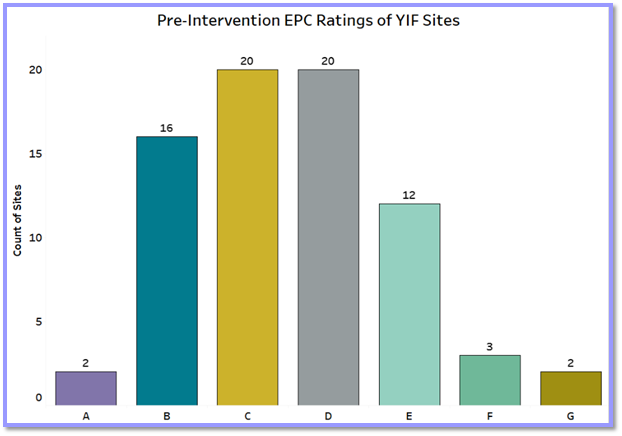
Across the 243 completed Youth Investment Fund (YIF) sites (as of March 2026), a subset of buildings demonstrates the transformative impact of capital investment on energy performance. Of these, 75 sites already had pre-intervention EPC ratings which are valid for 10 years, while 42 sites have obtained post-intervention EPCs.
Notably, 26 of these achieved an A rating with 16 of those in areas of IMD score 1-3, and 6 sites have an A+ rating, with half being in areas of IMD 1-3. These highest-performing buildings are largely associated with larger-scale construction projects (over 600sqm), though strong performance is also evident across mid-scale (350–600sqm), smaller sites (under 350sqm) and refurbishments or renovation projects. Additional results include 5 B ratings, 2 C ratings, and 2 D ratings.

Where both pre-and post-intervention data is available, the improvements are particularly striking.
- One site improved from a D rating to A+
- Two others moved from E ratings to B.
These shifts represent significant gains in energy efficiency and demonstrate the effectiveness of targeted capital investment in upgrading building fabric, heating systems, insulation, and overall design standards.
For community facilities, these improvements have tangible, real-world benefits. Research by Social Investment Business (2024) found that over 7000 community buildings do not meet EPC Rating C and energy efficiency is worse in the most deprived areas of the UK, with 3 in 5 community buildings in the most deprived areas of England not meeting the minimum EPC standards, over 60% of those in Northern Regions. Falling below minimum thresholds means the building could run into issues being rented or sold, directly impacting community groups and could affect the properties use capabilities.
Freeing up more for frontline services
Buildings with higher EPC ratings can be cheaper to run, reducing energy bills and freeing up limited operational funding for frontline services. This is especially important for organisations working with young people, where budgets are often constrained and demand for services is high. Improved energy efficiency also supports more stable indoor temperatures, better ventilation, and overall comfort, allowing for more frequent usage particularly in Winter months. Factors that are essential for creating safe, welcoming environments where young people can gather, learn, and engage.
“The funding has secured the future of our Scout group. The renewable technology in our new building; including solar PV, battery storage and air source heat pumps enable our running costs to be kept as low as possible. It means we can spend more money on young people instead of energy bills.”
Tom Hague, Sheffield High Green Scouts
In addition, energy-efficient buildings contribute to broader environmental goals, aligning community infrastructure with the UK’s net zero targets for 2030. For young people in particular, these spaces can also serve as visible examples of sustainability in action, reinforcing education and awareness around climate responsibility.
Futureproofing youth centres
Capital investment through the Youth Investment Fund has therefore played a crucial role not just in expanding or refurbishing physical spaces, but in futureproofing them. By improving EPC ratings, these investments enhance the usability, affordability, and sustainability of community assets. This ensures that youth facilities remain viable, accessible, and fit for purpose in the long term, supporting both current users and future generations.
Overall, the EPC data clearly demonstrates that investment in building quality directly translates into improved performance and greater community value. Continued focus on high energy standards in both new builds and refurbishments will be essential to maximise impact across the sector.
Future funding programmes should consider energy security more intentionally, reducing bills and contributing to Clean Power 2030 – and mitigating the risk of such features being value-engineered out.
Link to further research:
For media enquiries contact:
press@sibgroup.org.uk