
The Youth Investment Fund’s environmental impact
Introduction
Social Investment Business commissioned 2MD Regeneration to carry out a detailed review of the Youth Investment Fund’s impact on energy efficiency.
The findings demonstrate how the Youth Investment Fund (YIF) supported a wide range of meaningful improvements to youth facilities: increasing energy security, improving comfort and usability, and strengthening organisations’ resilience. Across very different projects, youth organisations were able to successfully include low-carbon technologies including solar PV, batteries and heat pumps while maintaining a focus on modern spaces fit for high-quality youth work.
Read the full report: The Youth Investment Fund’s Environmental Impact
Methodology
Eight YIF funded youth organisations agreed to take part as case studies for the project. Each organisation was sent a list of the points that the case study hoped to cover. As much information as possible was gathered from existing information held by Social Investment Business, planning application, BRUKL (Building Regulations UK Part L) documents, EPC (Energy Performance Certificates) and internet searches.
Each case study was then visited by the report’s author in order to develop the best understanding of the project, clarify any information gaps and gather data on utility use. Information was gathered through a semi-structured conversation with the senior staff and those responsible for day-to-day management. As a result, this report reflects the knowledge and opinions of the grantee rather than the designer or contractor.
Energy efficient spaces
Visiting the case studies showed the deep commitment to improving the lives of young people and the services available to them. In this regard the YIF investment in their buildings has been truly transformative. But it also showed the importance of having quality energy efficient spaces.
All the projects had previously operated from cold and inefficient premises. Not only is this demotivating for young people, for the staff it means more time spent managing and fixing the premises and less time spent on service delivery. For the finances it means more money spent on utility bills and less spent on trips and activities. For the planet it means more resource use and emissions with less focus on how young people value and access nature with all its wellbeing benefits.
The case studies all responded to the challenges in different ways and in this the vision of individual project leaders is key. Some are very focused on cheaper to run more comfortable spaces while others make clear links between the benefits for young people of quality spaces, net zero and wellbeing. Reducing costs, reducing emissions and improving wellbeing are not mutually exclusive, they are part of the same equation.

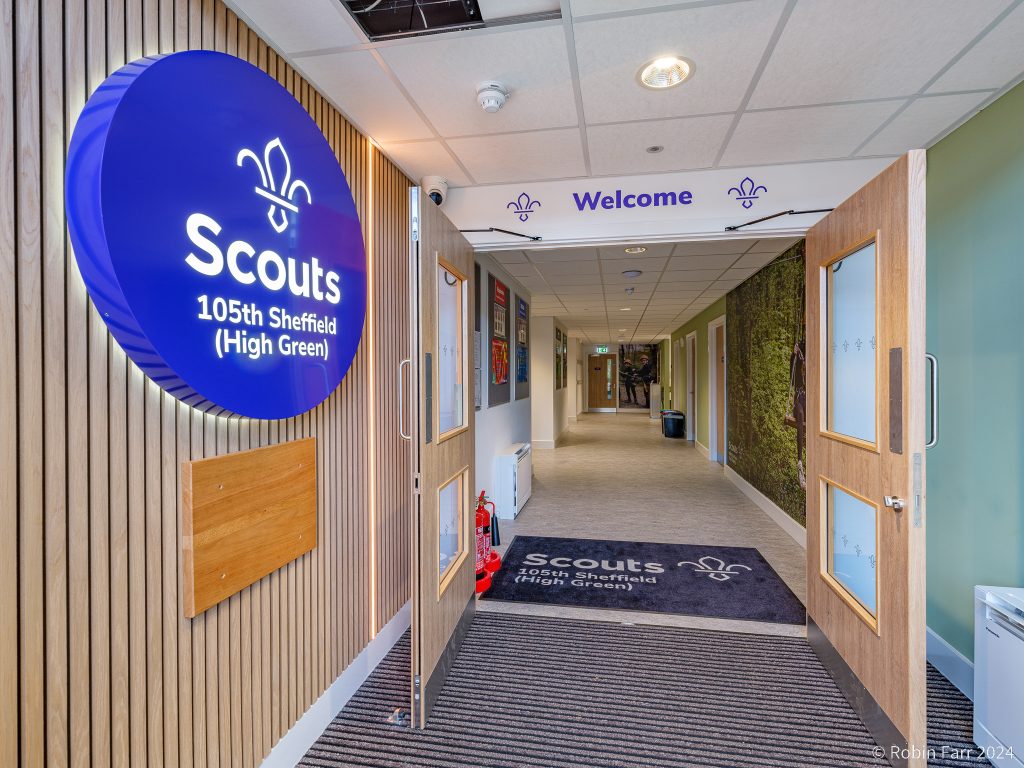
Spotlight on 105th Sheffield (High Green) Scouts
One of the case studies taking part in the project is 105th Sheffield High Green Scouts. Before receiving a Youth Investment Fund capital grant of £1,842,374.00 for a new building, the previous old Scout hut had been built in the 1960s. It was timber shed structure containing a large hall, kitchen and toilets. The timbers were rotting, there were vermin, it had no insulation and the windows were single glazed. It was very cold and draughty. With the amount of heating required it had a large carbon footprint and was very expensive to run. The hut had a gas combi-boiler for heating and hot water, traditional radiators and strip lighting.
The new Scout Building
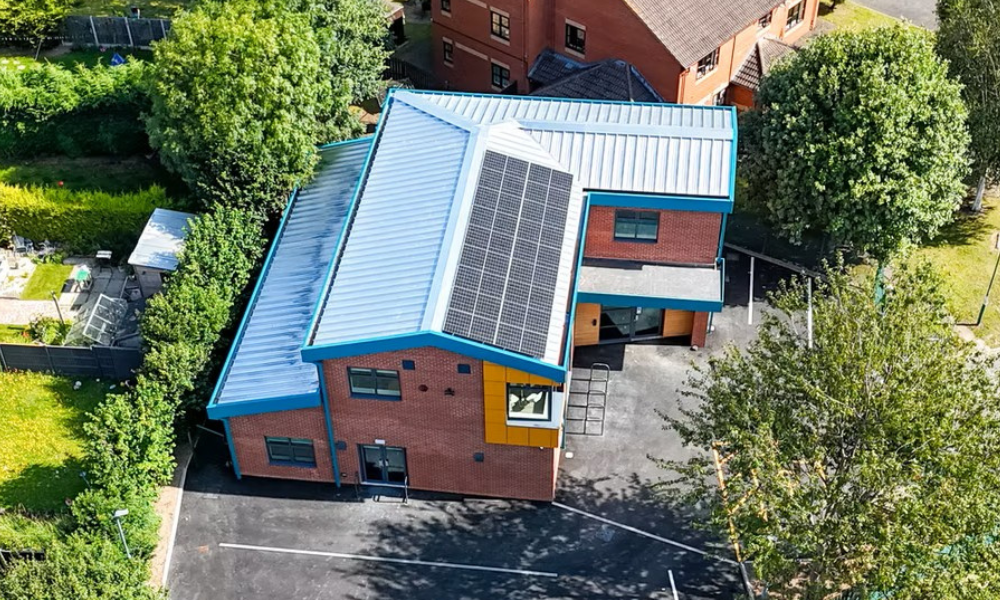
Construction started in August 2023, and the building was completed at the end of May 2024. New build headquarters building that is very close to its carbon neutral target and with some tweaking should achieve it.
Tom Hague, Scout leader for Sheffield High Green Scouts said:
“The funding has secured the future of our Scout group. The renewable technology in our new building; including solar PV, battery storage and air source heat pumps enable our running costs to be kept as low as possible. It means we can spend more money on young people instead of energy bills.”
Key Features
Solar: 48 solar panels generating 20kWp, fitted with optimisers to get the best output and with a roof pitch designed specifically for maximum solar gain.
Clean Heat: Fully equipped with air-to-air heat pumps providing heating, hot water and cooling as well as heat recovery units recycling heat from the building.
Batteries: 45kWh of battery storage. The Scouts are working to optimise the balance of solar power, battery storage and power imported from the grid.
Lighting: LED lights are fitted throughout
Impact
- Electricity bills in the summer can now be nearly £0.
- Net annual use of electricity from the grid is down to just 1,300kWh.
- EPC rating: -1 A+, better than the new build benchmark of 8 A.

Our learning
This report’s series of case studies outline what projects were able to achieve by investing in renewables and energy efficiency, as well as the challenges and lessons encountered along the way.
The learnings also highlight how centralised support and specialist expertise could further embed energy efficiency and resilience into capital investments, providing valuable insight for the design of future capital programmes from government and other funders. Unlocking energy resilience for the social sector remains a key priority for us at Social Investment Business. This learning is valuable as we continue to fund and advocate for energy improvements and we trust it will also prove to be a useful tool for any organisation considering energy efficiency within a major building project.
Read the full report: The Youth Investment Fund’s Environmental Impact
For media enquiries contact:
press@sibgroup.org.uk